Publications
2026
- SF
 Job Precarity and Earnings Inequality in Contemporary ChinaSocial Forces, 2026
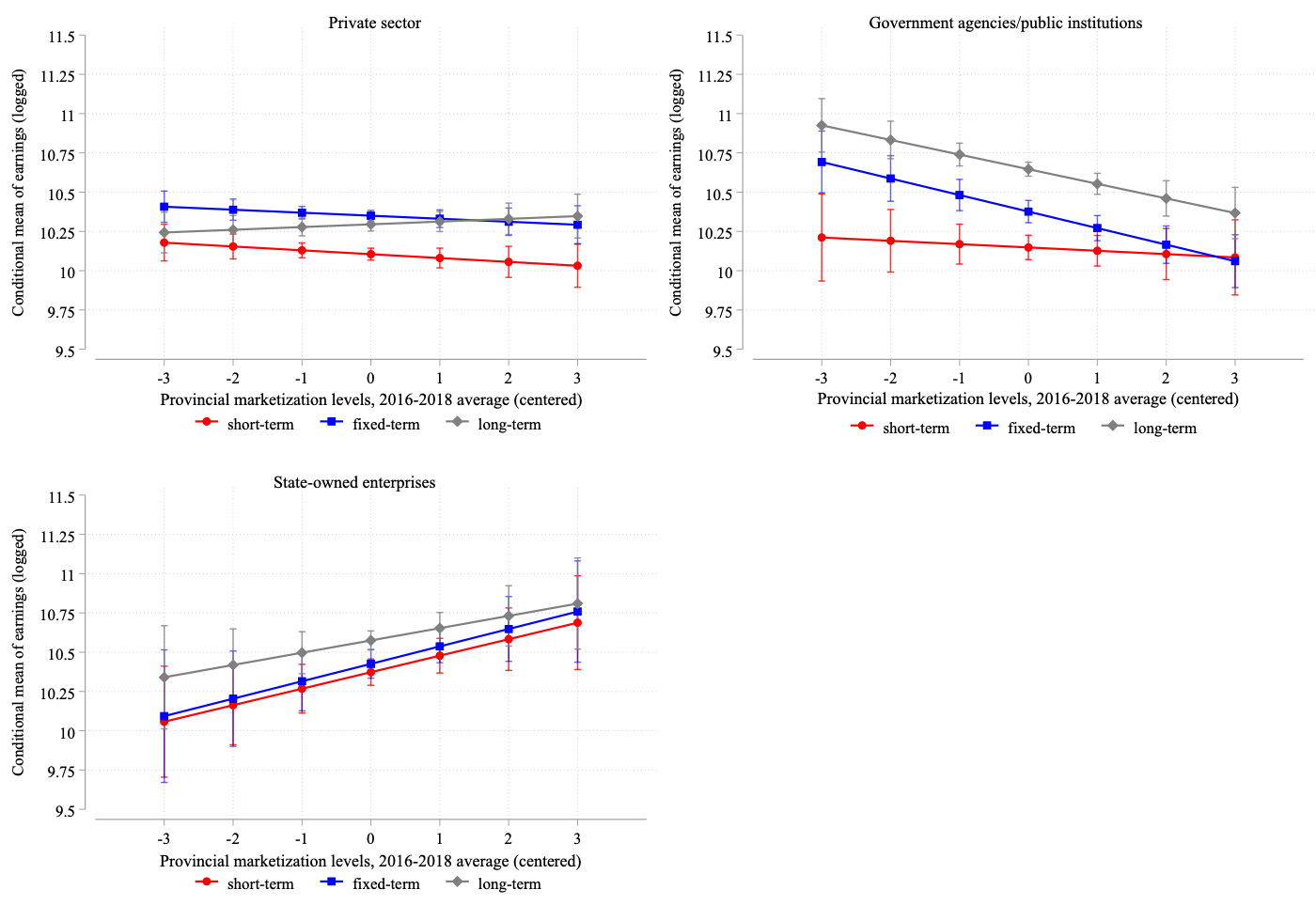
Job precarity is a core mechanism of workplace inequality that underlies economic segmentation between organizational insiders and outsiders. Yet less is known about how institutional contexts affect dual employment arrangements that create differential rewards between long-term and short-term workers. Drawing on institutional distinctions between China’s state and private sectors under marketization, this study shows how compensation for employment relations differ across sectors, how sector-specific returns vary with marketization levels, and how these differential returns contribute to overall earnings inequality within sectors. In the private sector, labor flexibility helps offset the costs of maintaining long-term employment through lower pay for short-term workers. In the state sector, the socialist personnel system preserves advantages for permanent employees, whereas the economic egalitarianism norms constrain the sustainability of these advantages under dual employment relations. Analyzing data from the nationally representative China Family Panel Studies 2018 and leveraging provincial marketization variations, I find that the state sector has less employment precarity than the private sector overall but imposes a larger earnings penalty on short-term employment. This penalty is smaller in more marketized provinces, mitigating overall earnings inequality associated with employment type within the state sector. In the private sector, however, both forms of inequality are larger in more marketized provinces. These within-sector earnings penalties and their association with marketization are most pronounced among low-paid workers, and cross-sector disparities are concentrated between government and public institutions and private enterprises. The findings challenge the view that marketization uniformly worsens precarious workers’ earnings and demonstrate the institutional foundations of labor market inequality in contemporary China.
2025
- JAE
 A Copula-Based Framework for Studying Intergenerational Income MobilityAnning Hu and Zhipeng ZhouJournal of Asian Economics, 2025
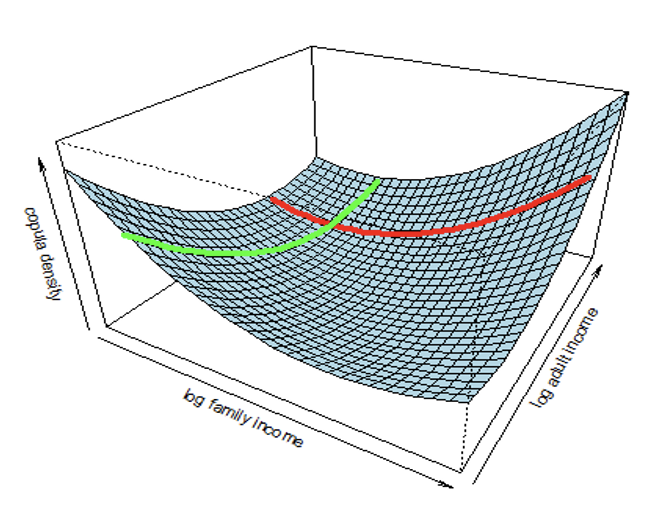
This study extensively elucidates the methodological advantages inherent in a copula-based framework for researching intergenerational income mobility: (1) By delving into copula density, one can shift the focus from a single summary index (such as the rank-rank slope or intergenerational income elasticity) to more nuanced mobility patterns that exhibit less sensitivity to marginal income distribution specifications. (2) With consistent marginal cumulative distributions, the framework enables the examination of changes in bivariate intergenerational income dependence, or morphology. This is achieved by assessing variations in copula density before and after accounting for relevant covariates, with the Cramér–von Mises statistic providing a user-friendly test for the statistical significance of these variations. (3) The copula-based framework, through the construction of different cross profiles on the copula density surface, accommodates research objectives related to both relative and absolute income mobility. To exemplify the application of this framework, we investigate intergenerational income mobility between 1978 and 2017 using the National Longitudinal Survey of Youth 1979 (NLSY79).
2024
- Socius
 The Effect of Intergenerational Income Mobility: Reachability-Based Conceptualization and Copula-Based MeasurementAnning Hu and Zhipeng ZhouSocius, 2024
Studies examining the consequences of intergenerational income mobility for individuals often face challenges due to multicollinearity between origin, destination, and a mobility construct based on the origin-destination difference. This article introduces a novel conceptualization of mobility, termed “reachability mobility,” which is based on the “easiness” of achieving a particular origin-destination combination within a population. This approach contrasts with the traditional lattice-based conceptualization. Furthermore, this study proposes using copulas—a statistical tool that captures the dependence structure between incomes of two generations while remaining insensitive to their marginal distributions—to measure reachability mobility. When combined with a standard measure of mobility direction, this approach allows scholars to simultaneously estimate the effects of origin, destination, and mobility along with numerous other methodological advantages. An illustrative example is provided that investigates the effect of intergenerational income mobility on mental health status using data from the National Longitudinal Survey of Youth 1979.
2022
- Int. J. Environ. Res. Public Health
 Factors Affecting the Job Satisfaction of Caregivers in a Home-Based Elderly Care ProgramXiao Rong , Zhipeng Zhou , and Yihui SuInt. J. Environ. Res. Public Health, 2022
Population aging has increased the demand for elderly care worldwide. The home-based elderly care system plays an important role in meeting this demand in developing countries. The quality of home-based elderly care is associated with the job satisfaction of caregivers in home-based elderly care programs, which has rarely been studied. This paper explores the factors that affect the job satisfaction of these elderly caregivers, including personal characteristics, working conditions, employment status, training, caregiver–client relationships, welfare, work experience, and burnout. It utilizes data from the Shanghai Domestic-work Professionalization Survey (SDPS), which was conducted among four types of in-home caregivers (n = 1000) in Shanghai over the period from May to September 2021. This paper selected a sample of elderly caregivers (n = 285) to examine their job satisfaction. The results show that gender, age, marital status, how they earned the job, relation with clients, social insurance, and work experience are significantly associated with the job satisfaction of in-home elderly caregivers, and their job satisfaction is negatively associated with their burnout levels. However, training and working conditions have no significant effect on the job satisfaction of in-home elderly caregivers, which is different from previous studies on formal care workers, such as nurses, in the institutional care system.