Publications
2025
- JAE
 A Copula-Based Framework for Studying Intergenerational Income MobilityAnning Hu and Zhipeng ZhouJournal of Asian Economics, 2025
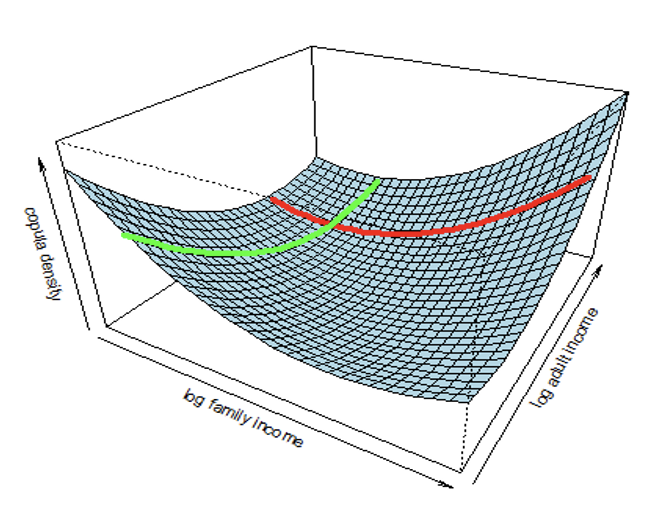
This study extensively elucidates the methodological advantages inherent in a copula-based framework for researching intergenerational income mobility: (1) By delving into copula density, one can shift the focus from a single summary index (such as the rank-rank slope or intergenerational income elasticity) to more nuanced mobility patterns that exhibit less sensitivity to marginal income distribution specifications. (2) With consistent marginal cumulative distributions, the framework enables the examination of changes in bivariate intergenerational income dependence, or morphology. This is achieved by assessing variations in copula density before and after accounting for relevant covariates, with the Cramér–von Mises statistic providing a user-friendly test for the statistical significance of these variations. (3) The copula-based framework, through the construction of different cross profiles on the copula density surface, accommodates research objectives related to both relative and absolute income mobility. To exemplify the application of this framework, we investigate intergenerational income mobility between 1978 and 2017 using the National Longitudinal Survey of Youth 1979 (NLSY79).
2024
- Socius
 The Effect of Intergenerational Income Mobility: Reachability-Based Conceptualization and Copula-Based MeasurementAnning Hu and Zhipeng ZhouSocius, 2024
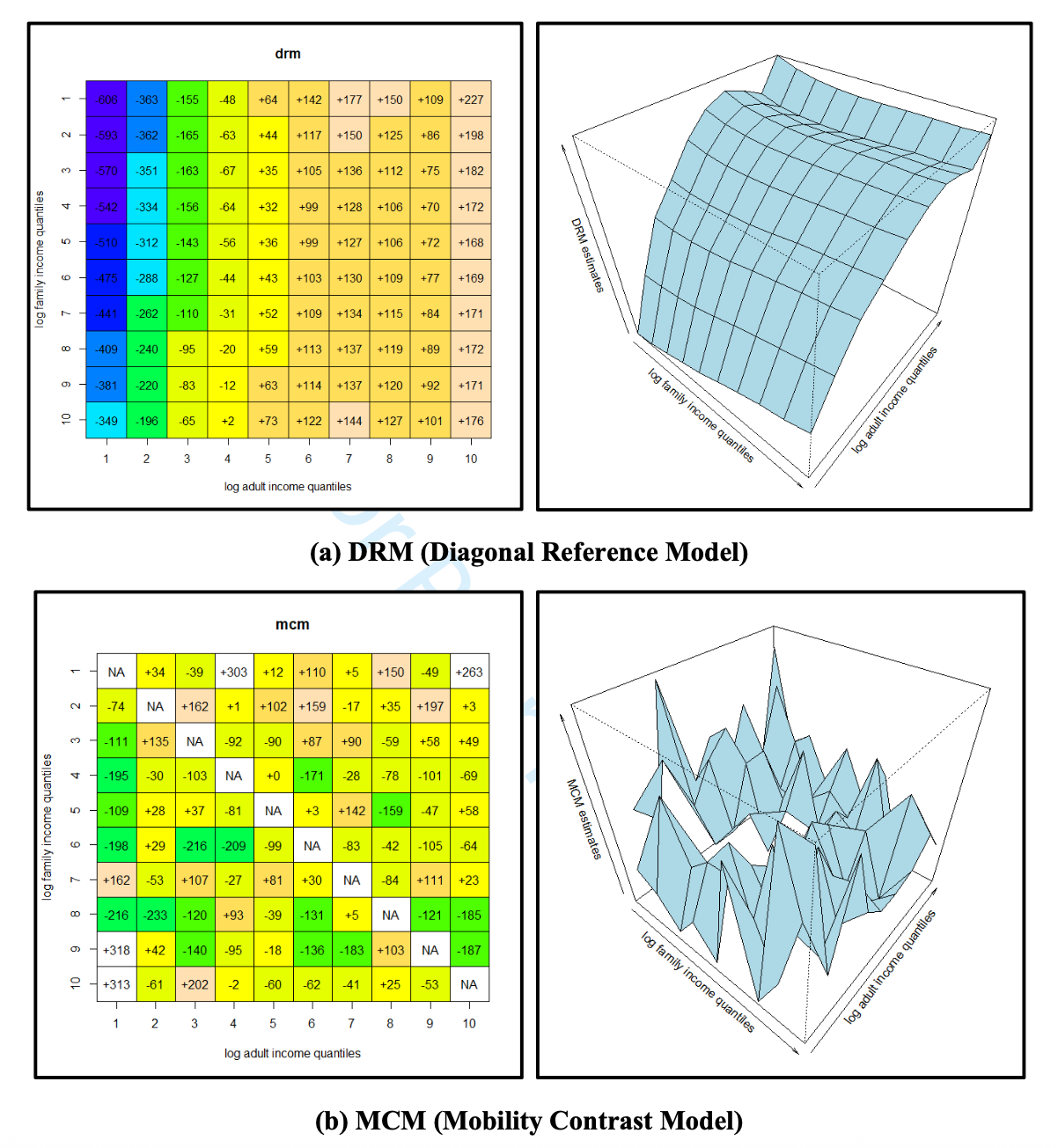
Studies examining the consequences of intergenerational income mobility for individuals often face challenges due to multicollinearity between origin, destination, and a mobility construct based on the origin-destination difference. This article introduces a novel conceptualization of mobility, termed “reachability mobility,” which is based on the “easiness” of achieving a particular origin-destination combination within a population. This approach contrasts with the traditional lattice-based conceptualization. Furthermore, this study proposes using copulas—a statistical tool that captures the dependence structure between incomes of two generations while remaining insensitive to their marginal distributions—to measure reachability mobility. When combined with a standard measure of mobility direction, this approach allows scholars to simultaneously estimate the effects of origin, destination, and mobility along with numerous other methodological advantages. An illustrative example is provided that investigates the effect of intergenerational income mobility on mental health status using data from the National Longitudinal Survey of Youth 1979.